Key points
- UK law requires workplaces to be kept sufficiently clean (Workplace Regulations 1992, regulation 9).
- Auditors look at floors, high level, loading bays, welfare areas, waste, pests and records.
- Start four to six weeks before an audit, and book high level cleaning early.
- Records matter as much as the cleaning itself.
Why cleaning decides so many warehouse audits
Whether it’s a BRCGS Storage and Distribution audit, a 3PL customer visit or an insurer’s survey, auditors form a view of a warehouse within minutes of walking the floor. Dust on racking, debris in the aisles, overflowing bins and tired welfare areas all suggest that other controls may be slipping too.
There is also a legal baseline. Regulation 9 of the Workplace (Health, Safety and Welfare) Regulations 1992 requires every workplace, and its furniture, furnishings and fittings, to be kept sufficiently clean, with waste not allowed to accumulate except in suitable receptacles. HSE’s guidance adds that cleaning itself must be done by an effective and suitable method without creating a health or safety risk.
The audit-ready warehouse cleaning checklist
We use a checklist like this with warehouse clients in the weeks before an audit. Start four to six weeks out so there’s time to fix what it finds.
| Area | What auditors look for | What to do |
|---|---|---|
| Floors and aisles | No debris, spills, packaging or tyre build-up in pick faces and walkways | Machine scrub aisles; clear packaging at every shift end; keep spill kits stocked |
| High level | No dust on beams, racking tops, lighting or ducting above stock | Book a high level clean every 6 to 12 months, and before major audits |
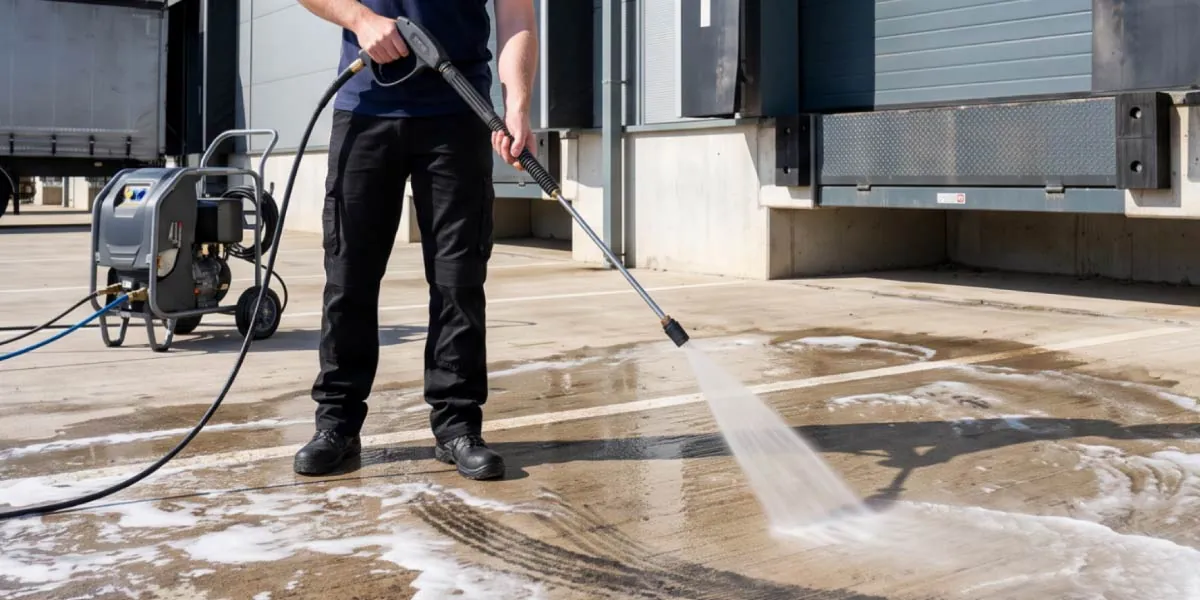
| Loading bays | Clean dock floors and levellers, clear drains, no pallet debris | Pressure wash bays; check drains and dock seals |
| Welfare areas | Clean washrooms, canteens and changing areas with stocked consumables | Daily cleaning and audited consumables |
| Waste | Segregated, labelled bins; no overflowing skips or loose waste | Colour-coded bins; scheduled waste collections |
| Pest control | Monitoring points mapped, logs current, no activity | Review pest contractor records and close any actions |
| Records | Cleaning schedules, sign-off sheets and audit trails | Keep schedules on display and quality audits on file |
Based on the cleaning areas we audit on ProFM warehouse contracts.
How often each area should be cleaned
Frequency depends on traffic and what you store, but this is a sensible starting point for a busy warehouse: aisles and welfare areas daily, spills as they happen, loading bays weekly, high level racking every 6 to 12 months, and a full deep clean once or twice a year (quarterly for factories and food sites). Plan the deep clean a week or two before your audit, not the day before.
Daily warehouse cleaning checklist
Use the daily, weekly and monthly cleaning tasks below as a starting warehouse cleaning checklist, then adjust it for what you store and how busy each area is.
The daily tasks keep the warehouse environment safe and stop dirt building up between deeper cleans. Most can be done by warehouse staff at shift end or by a cleaning team working around operations.
- Sweep or machine scrub main aisles, pick faces and walkways, and clear debris, shrink wrap and packaging waste.
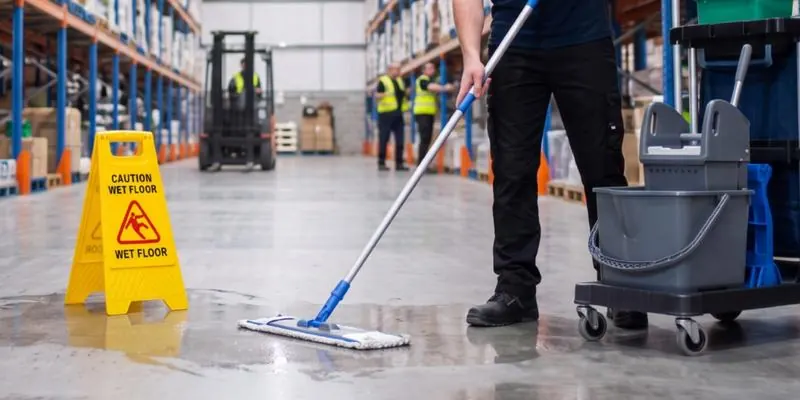
- Deal with spills straight away and mop floors in wet areas so there are no slip or trip hazards.
- Empty bins and move packaging waste to the right segregated stream.
- Clean and restock washrooms, the break room and kitchen areas.
- Wipe shared touchpoints: door handles, light switches, handrails, keypads, scanners and shared equipment.
- Check that fire exits, walkways and loading bays are clear.
Weekly warehouse cleaning tasks
- Clean loading docks and dock levellers, and remove pallet debris from bays.
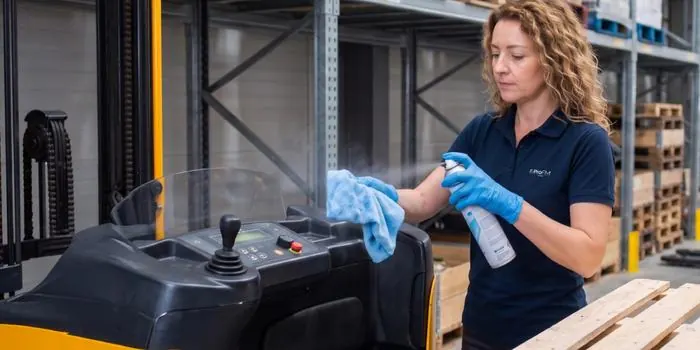
- Wipe down forklift trucks, pallet trucks and charging areas, following the manufacturer’s guidance.
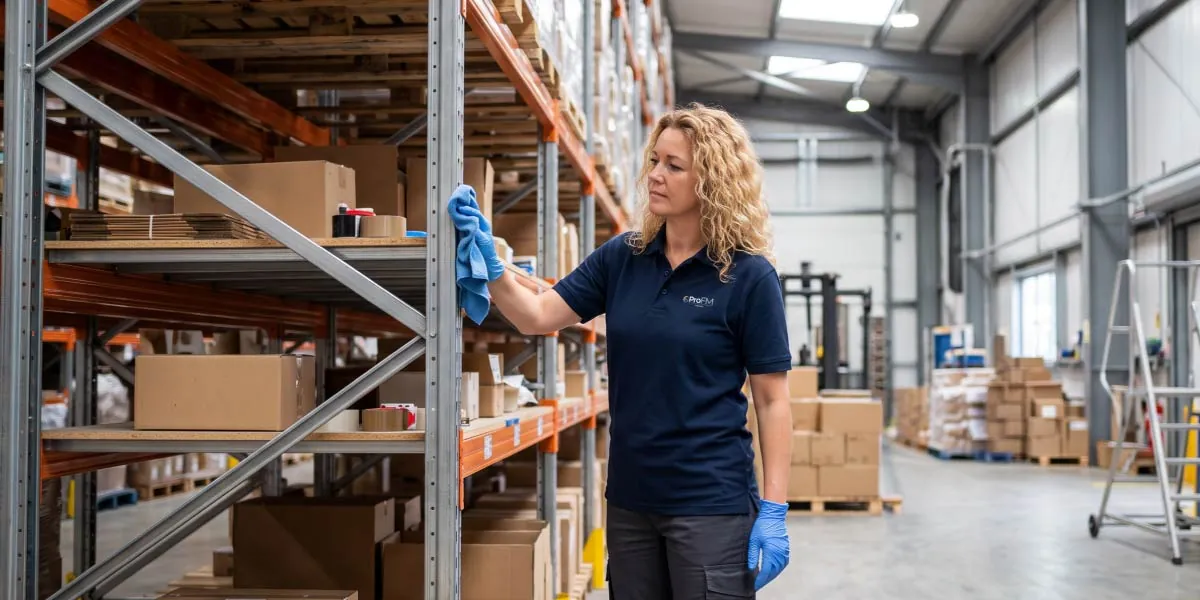
- Dust low-level racking, packing benches and storage areas.
- Clean offices, meeting rooms and welfare areas more thoroughly, including fridges and microwaves.
- Check spill kits, PPE stock and cleaning equipment, and replace anything worn.
Monthly warehouse cleaning tasks
- Deep clean warehouse floors with a scrubber dryer and remove tyre marks from high traffic routes.
- Clean windows, roller doors and dock seals.
- Clean external areas: yards, bin stores, smoking shelters and car parks.
- Check drains and gullies are flowing, especially in loading bays.
- Review cleaning records and quality audits, and act on any repeated issues.
Periodic deep cleaning tasks
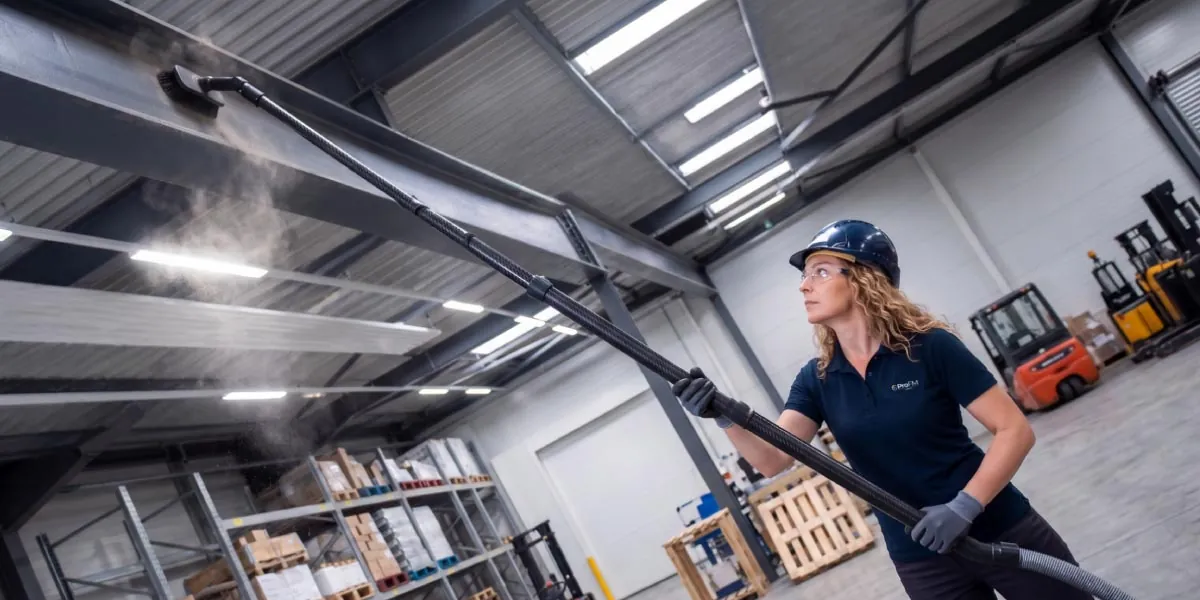
Every six to twelve months, most warehouses need a periodic deep cleaning visit that day-to-day cleaning cannot reach. That usually covers high level dusting of racking tops, beams, lighting and ducting, pressure washing of loading bays and yards, and a full clean of machinery and plant rooms. Food, pharmaceutical and chilled sites often need this quarterly. Because high level work needs access equipment, trained operatives and a risk assessment, it is worth booking well before an audit.
Health and safety when cleaning a warehouse
Cleaning a live warehouse brings its own risks. Forklift trucks, reversing HGVs, high level work and chemicals all need managing. A good cleaning checklist sits alongside a risk assessment and safe systems of work, so teams understand where they can and cannot work and when.
- Use barriers and signage near forklift routes and clean zone by zone.
- Use the right equipment for each floor type and task, and train staff to use it.
- Store and use chemicals in line with COSHH, especially near hazardous materials or food.
- Record every task so you can show auditors and inspectors what was done and when.
In-house or professional warehouse cleaning?
Many sites keep simple daily tasks in-house and bring in professional warehouse cleaning for scheduled, specialist and high level work. That works well when the in-house team has time and the right equipment. Where it falls down is consistency: cleaning is often the first task dropped when volumes rise. A contract cleaning team with its own supervisor, schedules and quality audits helps maintain standards all year, set expectations clearly and keep the records that audits demand. Every site has individual requirements, so we tailor the schedule after a free site survey rather than using a fixed template.
What a clean warehouse does for safety, operations and compliance
Cleanliness is not just about appearance. A clean warehouse is a safe workplace: fewer slips and trips, clearer walkways for forklift trucks and less dust on stock and machinery. It also supports smoother warehouse operations, because pickers can find locations quickly, loading docks stay clear and equipment lasts longer when dirt and debris are not grinding into moving parts.
For storage facilities handling food, pharmaceuticals or packaging, hygiene standards are part of the contract with your customers. A documented cleaning schedule, regular inspection of key areas and clear waste management help ensure compliance with your customers’ requirements, BRCGS and HSE guidance. They also give you evidence for safety inspections, insurer visits and audits.
Best practice is to treat the warehouse cleaning checklist as a live document. Review it after each audit, after any change in what you store and whenever the site layout changes. A large amount of new stock, a new mezzanine or extra shifts at peak can all change what needs cleaning, how often and when.
Maintaining safety standards between deep cleans
The gap between periodic deep cleaning visits is where standards slip. Simple habits make the difference: clean as you go at every packing bench, wipe surfaces and shared touchpoints at shift change, keep bins emptied before they overflow, and report damaged floors or leaking roofs straight away. A cleaning supervisor or nominated team leader who walks the warehouse environment daily and signs off the checklist keeps everyone accountable.
Professional cleaning services can carry these routines for you, with trained operatives, the right equipment for each floor and surface, and quality audits that show what was cleaned, when and to what standard. That frees your own team to focus on picking, packing and despatch, and keeps the facility audit-ready all year rather than for one week.
Five mistakes we see before audits
How we approach it
ProFM Group delivers more than 5,000 hours of cleaning every week for over 1,000 clients. Our teams are BICSc members and we hold ISO 9001, ISO 14001 and ISO 45001. For warehouse clients we start with a free site survey, agree tasks, frequencies and shift timings in one schedule, and run regular quality audits with a monthly review, so the site stays audit-ready all year rather than just the week before.
Sources
- legislation.gov.uk: The Workplace (Health, Safety and Welfare) Regulations 1992
- HSE: L24 Workplace health, safety and welfare, Approved Code of Practice
- BRCGS: Global Standard for Storage and Distribution
- HSE: Slips and trips in haulage and distribution

ProFM Group (formerly Churchill Support Services) has protected and cleaned UK businesses since 1996. Our security officers are SIA-licensed and vetted to BS 7858, our cleaning teams are BICSc members, and every shift is overseen by our National Operations Centre in Chorley. This guide draws on what we see every week on the warehouse, logistics and manufacturing sites we look after.